|
26A019 The Need for Rivals by Jim Davies, 5/12/2026
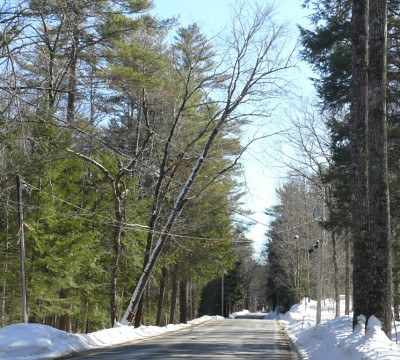
On the edge of my property is a big, healthy tree; but it leans. Its roots are on my side of the road, but the top tips of its leaf buds hang over the far side of the road, menacing a telegraph pole, hung with its cables for electric power, phone, TV and Internet. Five months ago, someone tied a red tape around its trunk, equivalent in treedom to a death warrant. I suspect Eversource, the power co, tied it; but whoever, I concur. The tree needs to come down, and although I can fell lesser trees, this is beyond my ability. I've called the Town road agent, and tried to call Eversource, but to no avail. The latter answered with a machine that did not allow humans to respond without a 60-minute wait. Obviously, they are not interested in helpful customer feedback. Why so? They have no competitors. Like government, they have a monopoly. So when the tree falls in the next storm and creates a bunch of havoc and expense, they will respond quickly but at heavy cost, which they will pass on to customers in the form of higher rates per kilowatt hour. Why not? - they have no rival, to offer users a lower rate. Competition is missing, on a local level. And the country is carved up into a series of local monopolies, as it is for phones. One of the users of the telegraph poles is TDS Telecom, who provide a good, fast Internet service with fiber optic cable. There has been no rival for them either, in this somewhat rural area; so they can get away with charging $80 a month to connect. Happily, this year other firms have begun to offer Net wifi connections via their 4G and 5G cell networks, for around $45/mo; Verizon is one, and Xfinity promotes theirs here. Guess what: out of the blue, TDS dropped their price to $55, presumably hoping that I and others will not be tempted to leave them for a mere $10 advantage. I'll keep 'em guessing a while. Such is competition. It's how the market works, to keep prices as low as possible, consistent with profitability. Monopolies don't last long, for nimbler rivals find a way around them. Except for government; because it prohibits competitors. So its monopolies last for lifetimes, and its employees can rest easy in the knowledge that they will get paid regardless of how well they work. Examples: its "justice system", which is broken almost beyond repair and even when it does work, delivers retribution instead of restitution; and its "defense" system which costs around a trillion dollars a year and may defend other nations (as now, in the Mid East) but not us in the US of A because nobody ever attacked us. Also worthy of mention is its Social "Security" system, which insures old age with benefits about half of what they would be in a competitive, commercial environment, and come only at the whim of Congress. There are, of course, tens of thousands of other, lesser functions from which rivals are excluded. When TOLFA graduates decline to work for government in any capacity it will all implode, and will take its monopoly functions with it, thereby opening up a wealth of opportunity for innovative companies to replace those for which a market demand exists, on a proper competitive basis. Prices will settle to optimal rates and will be kept there by rivalry as above. And where no market demand is detected, the function will vanish altogether and its employees will look for and find productive work. Human progress will accelerate. 
It's said a man needs a government like a fish needs a bicycle. I think it's worse than that. The situation is more akin to telling the fish he can't survive without the bicycle, forcing him to buy one, tacking him to its seat to force him to ride it, and then demanding he thank you for the bike you've provided. - Kent McManigal 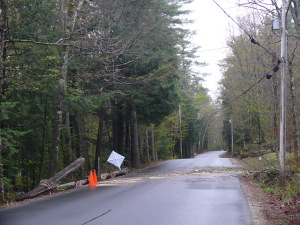 STOP PRESS STOP PRESSDrama in the Dead of Night Loosened by rain on May 9, the soil and rocks finally failed the fibers of the tree roots and down it came as predicted, at about 2 a.m. on the 10th. It was a graceful degradation more than an almighty thump, and the trunk twisted a little so that it hit the power cable but not the pole and all others attached. The stump remains, to poke an accusing finger at the evils of monopoly. |
|
||||||||||||||||||||||||||||||||||||||||||||||